

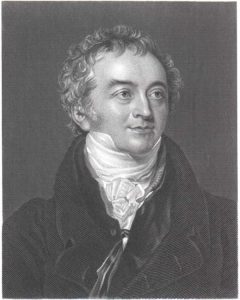
THOMAS YOUNG
Thomas Young was an English polymath (a person with encyclopedic or varied knowledge or learning) who contributed to the scientific understanding of vision, light, solid mechanics, energy, physiology and Egyptology.. So great was his knowledge that he was called “Phenomena Young” by his fellow students at Cambridge.
Young was born in 1773, the eldest of 10 children. By the age of fourteen, he had learned Greek and Latin and was acquainted with French, Italian, Hebrew, Chaldean, Syriac, Samaritan, Arabic, Persian, Turkish and Amharic, a Semitic language spoken in North Central Ethiopia.In 1792, Young began to study medicine in London. He later moved to Gottingen, where he obtained his doctorate in physics in 1796. A year later, in 1797, Young entered Emmanuel College at Cambridge. By 1799, Young had established himself as a physician in London where he published many of his first academic articles anonymously to protect his reputation at a physician. It is to be noted that while studying medicine in London, he explained the mode by which the eye accommodates itself to vision at different distances as depending on change of the curvature of the crystalline lens. This was to prove valuable to him being the first to describe astigmatism.
In 1801, Thomas Young was appointed professor of natural philosophy (mainly physics) at the Royal Institution in Cambridge. His initial interest in light and vision carried over to this new academic endeavor. Here, Young presented the hypothesis, later developed by Hermann von Helmholtz, that color perception depends upon the presence in the retina of three kinds of nerve fibers which respond respectively to red, green and violet light. This theory was experimentally proven in 1959, one hundred fifty eight years later!
While at Cambridge, Young performed his now famous double slit experiment where he passed a beam of light through two parallel slits in an opaque screen, forming a pattern of alternating light and dark bands on a white surface beyond which established that light was a transverse wave motion whose wavelength determined color (see wave interference). His findings were strongly opposed by contemporary scientists who believed that Newton, who had proposed that light was corpuscular in nature, would not possibly be wrong. However, Young’s work was soon confirmed by the French scientists, Fresnel and Arago.
For more information on this topic please visit www.lenoxlaser.com